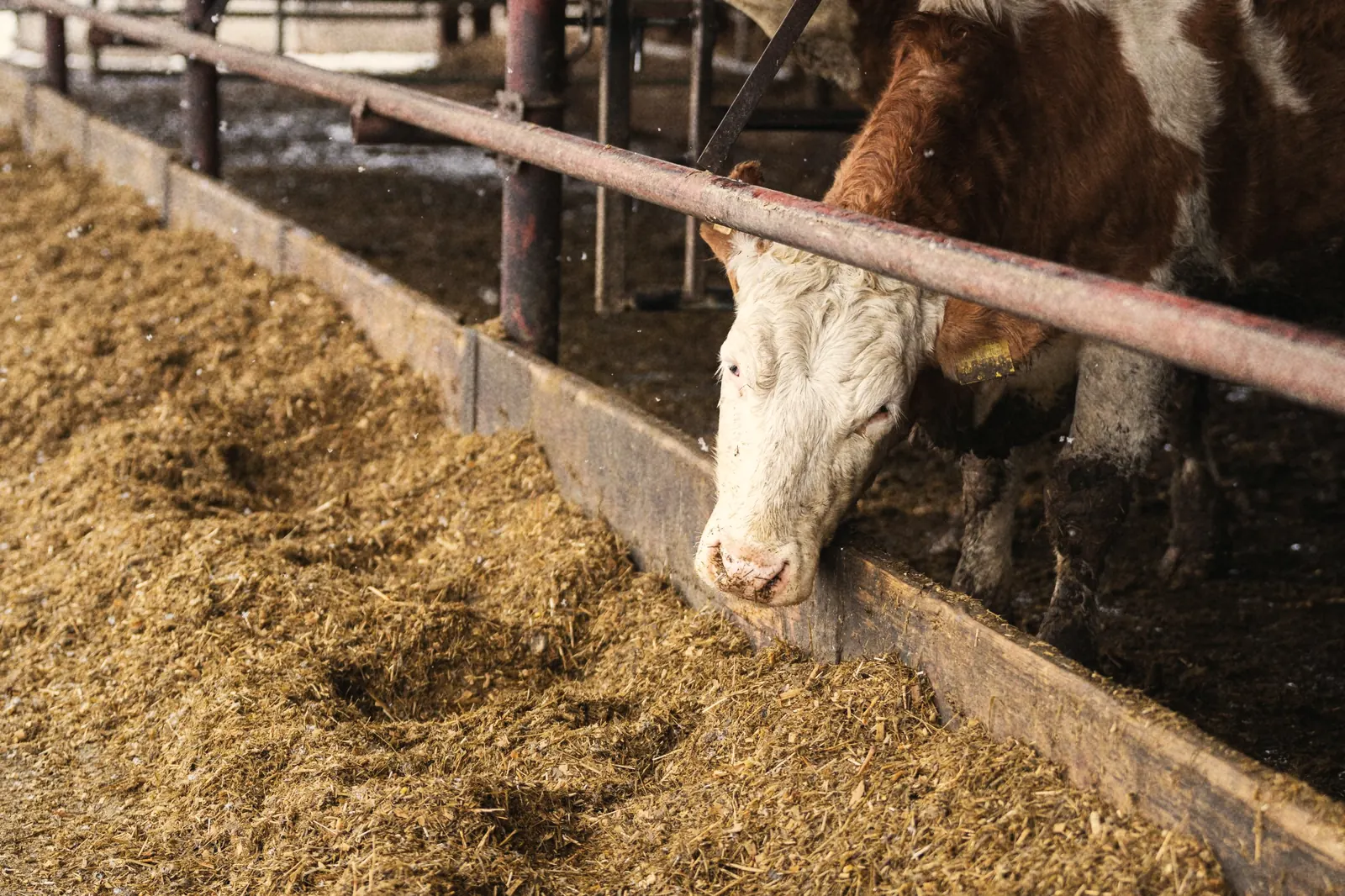
Profectus Livestock Solutions

Profectus — Turning NetSuite Into a Workspace Every Role Actually Uses
A Benmore Technology case study, in partnership with Profectus Livestock Solutions (Worthington, MN).
1. Project Basics
- Project name: Profectus Operations Platform
- Client: Profectus Livestock Solutions, Dan Greve (CFO)
- Client LinkedIn: Dan Greve on LinkedIn
- Company website: profectuslivestock.com
- Live app: crm.profectuslivestock.com
- In one sentence: A custom CRM that sits on top of Profectus's existing NetSuite system and gives each person (vets, nutritionists, sales reps, finance and office staff) a simple, personal workspace for their own daily work, on a phone or a desktop.
Who uses it, and what they get:
| Who | What they get |
|---|---|
| Sales reps and account executives | Customers, routes, visit prep and orders |
| Veterinarians | Herd health records, lab results and medicine plans for each farm |
| Nutritionists | Feed rations, pricing and quotes |
| Finance and accounts receivable | Balances, statements, budgets and quarterly reviews |
| Office and operations staff | Orders, shipments and customer paperwork |
| Leadership | Company-wide health, goals and reporting |
| Admins | Who can see what, web forms and team setup |
2. The Situation Before Us
Profectus is a livestock company that sells animal health products, vet services and feed to farms across the Midwest and beyond. It has about 50 staff spread across a large region, and more than 1,800 customer accounts.
All of the company's data already lived in NetSuite, its accounting and operations system. The data was good. The problem was getting to it. NetSuite is built for accountants, not for a vet standing in a barn or a rep driving between farms. Staff used it as a makeshift CRM, and filled the gaps with a patchwork of other tools: a separate payments vendor (VersaPay), email, spreadsheets, documents and roughly 50 paper notebooks kept by people in the field.
In early 2026, like much of the industry, Profectus's leadership saw what AI tools could do. Dan and his colleague Brian tried building early prototypes themselves with AI app builders. They got working demos quickly, but soon realized a demo is not a product. They couldn't put it in front of 50 staff and real customer data with any confidence. They needed a team that could take the vision to production.
The specific pain points:
- Data was there, but hard to use. Answering a simple question such as "how is this customer doing?" meant clicking through several NetSuite screens. Every role paid that cost many times a day.
- No route planning. Vets and reps visit farms spread across several states. NetSuite has no way to plan a day's route, so staff built them by hand in Google Maps.
- Budgets ran on spreadsheets. Finance emailed spreadsheets out each year for people to fill in budgets, then stitched the answers back together by hand.
- Product lookup was slow. Nutritionists and reps had to search a catalog of about 6,500 products to find the 20 or so a given farm actually reorders.
- Paperwork ate hours. The monthly customer statement run took 10 to 12 hours of printing, folding and mailing. Writing up and sending a single vet note took about 10 minutes of copying into a Word template.
- Knowledge was walking out the door. Long-time staff carried key customer knowledge in their heads and notebooks. As people retired, that knowledge went with them, and new hires had a steep climb.
- Growth made it worse. The company was growing quickly, and every new hire and new account added to the friction.
Everyone felt this: field staff lost time to lookups and admin, the back office lost days to manual cycles, leadership couldn't see the whole picture, and customers waited longer for answers.
3. Discovery & Scoping
Profectus came to us with a big, ambitious wish list: a CRM with voice AI, dashboards, data pulled together from every source, customer management, AR management, customer portals and more. They had already sketched an early clickable prototype, which gave us a head start: we could react to something real instead of a blank page.
We shaped the vision together. Benmore proposed how the pieces should fit, which shared building blocks to use and how each screen should behave, and Profectus kept us grounded in how the work really happens on a farm. Rather than meeting every day, we met at major milestones, including two live demos: one at the midpoint checkpoint and one near the finish for final adjustments. Each demo led directly to a round of changes.
To keep scope under control, we split the work into phases:
- Phase 1 (launched): the team workspace: customer views, account health, routes, visit briefs, tasks, orders and quotes, vet and nutrition tools, reports, web forms, permissions and the NetSuite connection.
- Phase 2 (next): replacing VersaPay with Stripe for payments, and self-serve customer payments.
- Phase 3 and beyond (planned): more advanced AI advice and insights.
The core idea we kept coming back to:
Don't replace NetSuite. Make it usable. All the data was already there. It was just scattered and hard to reach. Our job was to bring it together in one place, show each person only what they need, and send their work back into NetSuite so it stays the single source of truth.
Wherever an existing tool was doing a job we could do better inside the platform, we replaced it.
4. The Solution We Built
Major modules delivered
-
Account overviews with health colors. Click any customer and see everything in one place: balances, open orders, recent purchases, contacts and history. Every account is marked red, yellow or green based on how it pays and how often it orders, so staff can focus on the accounts that need attention instead of reading every record.
-
AI pre-visit briefs. Before a farm visit, the platform writes a short briefing that pulls together recent notes, open tasks, orders and balances. A rep or vet walks in already knowing what matters.
-
Route planning for field staff. Every customer sits on a map. Staff pick their stops, get a driving route with miles and drive time, print a route sheet, open the briefs for each stop, and send the route to Google Maps on their phone. Routes can be downloaded for areas with no signal.
-
Voice notes and offline capture. Staff can talk instead of type. A voice note recorded in the field is transcribed and filed against the right customer, even if it was recorded with no signal and synced later.
-
Tasks, notifications and messaging. A full task manager where staff can tag teammates, get notified, and email or text customers directly from the customer record. Every message is logged, and texting respects each contact's opt-in.
-
Orders and quotes. Each customer's most-ordered products appear first, so staff skip the 6,500-item catalog. Orders can be built by tapping favorites, searching, or dictating by voice, then saved as a draft, sent as a quote, or turned into a sales order for NetSuite. A product without a confirmed price shows as "pending", never as $0, so no one sends a wrong quote.
-
Veterinarian tools. Vets manage the formal vet-client relationship records (VCPRs) for each farm, upload lab and diagnostic results, and turn spreadsheets of results into clean reports. The platform reads uploaded files automatically, so vets don't retype numbers, then builds medicine reports to share with the farm.
-
Nutritionist tools. Nutritionists build feed rations on an order board, price them, and send them to the customer as a PDF or text message.
-
Finance, AR and quarterly reports. Finance can see what every customer owes alongside lifetime value, retention and churn, and build a branded quarterly review for each customer in a few clicks, covering orders, product mix, ordering frequency, balances over time, budget against actual and price changes, either for internal use or to send to the customer. Budgets are collected inside the platform instead of by emailed spreadsheets, and leadership can set and track goals for the sales team.
-
Web forms that capture demand. The customer forms on Profectus's long-standing website, such as credit applications, tax exemption certificates and vet letters, are now built and managed in the platform. Staff can send forms to customers to fill out and sign, approved answers land straight on the customer record, and the team gets detailed analytics on who opens, edits and submits each form.
-
Admin and permissions. Admins control exactly who sees what. A vet who also needs nutrition tools can be given both. There is a role for each team and more than 170 individual permissions, so a nutritionist never sees AR balances and an AR clerk never sees medical records.
-
Two-way NetSuite connection. The platform pulls customers, contacts, orders, invoices, payments, pricing and vet records from NetSuite automatically, and is built to send work such as quotes, orders, activity and signed forms back into it. NetSuite stays the official record, and the platform never becomes a second, competing copy.
Technology stack
- Backend: Go, with Huma, Chi, pgx and River
- Frontend: TypeScript, Next.js, React, TanStack Query and Zustand
- Database: PostgreSQL on AWS
- Caching and background jobs: handled inside PostgreSQL, so there is no extra server to run or pay for
- Hosting: AWS (ECS Fargate, RDS, S3, CloudFront, WAF, Route 53, CodeBuild), in Profectus's own AWS account
- Connected services: NetSuite, AI models for briefs and summaries, AWS voice transcription, AWS document reading, AWS text messaging, Google Maps, and Stripe (Phase 2)
5. Implementation Details
- Challenge: Many roles, very different needs. A vet, a nutritionist, a rep and an AR clerk work with the same customers but need different views, and some information must never cross over.
-
Solution: Permissions built in from the start. Who can see what is checked for every request, not just hidden on screen. One permission model covers every role, and admins can combine roles for people who wear more than one hat.
-
Challenge: Gathering needs from every team, fast. Each team had its own pain points and its own way of working.
-
Solution: Talk to each person, then generalize. We spoke with each team to understand their day, then turned their individual needs into one shared design.
-
Challenge: Building a lot without losing consistency. Seven different groups of users, one product.
-
Solution: Shared building blocks first. Before building screens, we agreed on the core data every part shares (a customer, an order, a task) and a common set of screen components. Each role's workspace is assembled from the same parts, so new features came quickly and everything feels the same.
-
Challenge: Two systems that must always agree. Work done in the platform has to land in NetSuite correctly, without duplicates or overwrites.
- Solution: NetSuite stays in charge. Changes are checked against NetSuite and reconciled, so there is always one official record.
Platforms: a web application designed for phones first. It is not an app-store app, but every feature works on a phone, a tablet and a desktop, which was a firm requirement for staff who spend their days in trucks and barns.
6. Results & Outcomes
- Launched Monday, November 16, 2026, ahead of the projected timeline. A fully working web application that works just as well on a phone.
- Built on NetSuite, not beside it. NetSuite remains the system of record: the platform reads from it automatically and is built to write work back to it.
- Fewer tools to pay for and juggle. Route planning, budget spreadsheets, form tools and much of the email back-and-forth now live in one place.
- Each person sees only their work. Every role has a focused dashboard with the information it needs and nothing it doesn't.
Before and after:
- Checking on a customer: several NetSuite screens → one page, with a red, yellow or green health color
- Planning farm visits: by hand in Google Maps → pick stops on a map, get the route, send it to your phone
- Preparing for a visit: digging through notes and notebooks → an AI briefing for every stop
- Finding the right product: searching about 6,500 items → the farm's usual products are shown first
- Budgets: emailed spreadsheets stitched back together → collected inside the platform
- Quarterly customer reviews: pieced together by hand → built in a few clicks
- Customer forms: on the website with little insight → sent, signed and tracked in one place
- Everyone: the same cluttered system → each role sees only its own work
Business impact:
- New capabilities: AI visit briefs, voice capture in the field, account health at a glance, detailed web-form analytics and fine-grained access control.
- Benefits for staff and customers: faster answers for farms, records that survive staff turnover, and much easier onboarding for new hires.
- Growth (projected): with better visibility into web-form demand and customer reporting, Profectus expects 10 to 15% year-over-year growth supported by the platform.
- Savings (projected): Phase 2 replaces VersaPay with Stripe, projected to save more than $40,000 a year.
What the client is saying
Read the client's review on Trustpilot
The partnership continues into Phase 2 and Phase 3, starting with the move from VersaPay to Stripe.
7. Lessons Learned
- Augment, don't replace. Profectus didn't need a new system of record. It needed its existing one to be usable. Building on top of NetSuite was faster, cheaper and less risky than migrating away from it, and kept the company's history intact.
- Discovery pays for itself. Time spent up front on shared data and shared components made every later feature faster to build. Adding a new role became assembling known parts rather than starting over.
- Talk to every role, then design for all of them. The best features came from sitting with each team and hearing their day. The design held up because we built it from real needs, not guesses.
- Demo at milestones, not every day. Two well-timed live demos, at the midpoint and near the finish, gave the client real control over the product without slowing the build.
- Mobile isn't optional in the field. Designing for the phone first, not shrinking a desktop app, is what made the platform usable for people in trucks and barns.
Watch the films
All case studies Includes a short film, Film · 1:33
Cattle Logic
A mobile operating system connecting intake, feed, animal records, inventory, and invoicing, with offline workflows for the field.
 Includes a short film, Film · 1:35
Astra Wellbeing
We built the healthcare recognition platform and supported Astra as the business grew.
 Includes a short film, Film · 1:53

The 357 Company
Shipping, labels, and carrier onboarding for a logistics business that went on to be acquired.