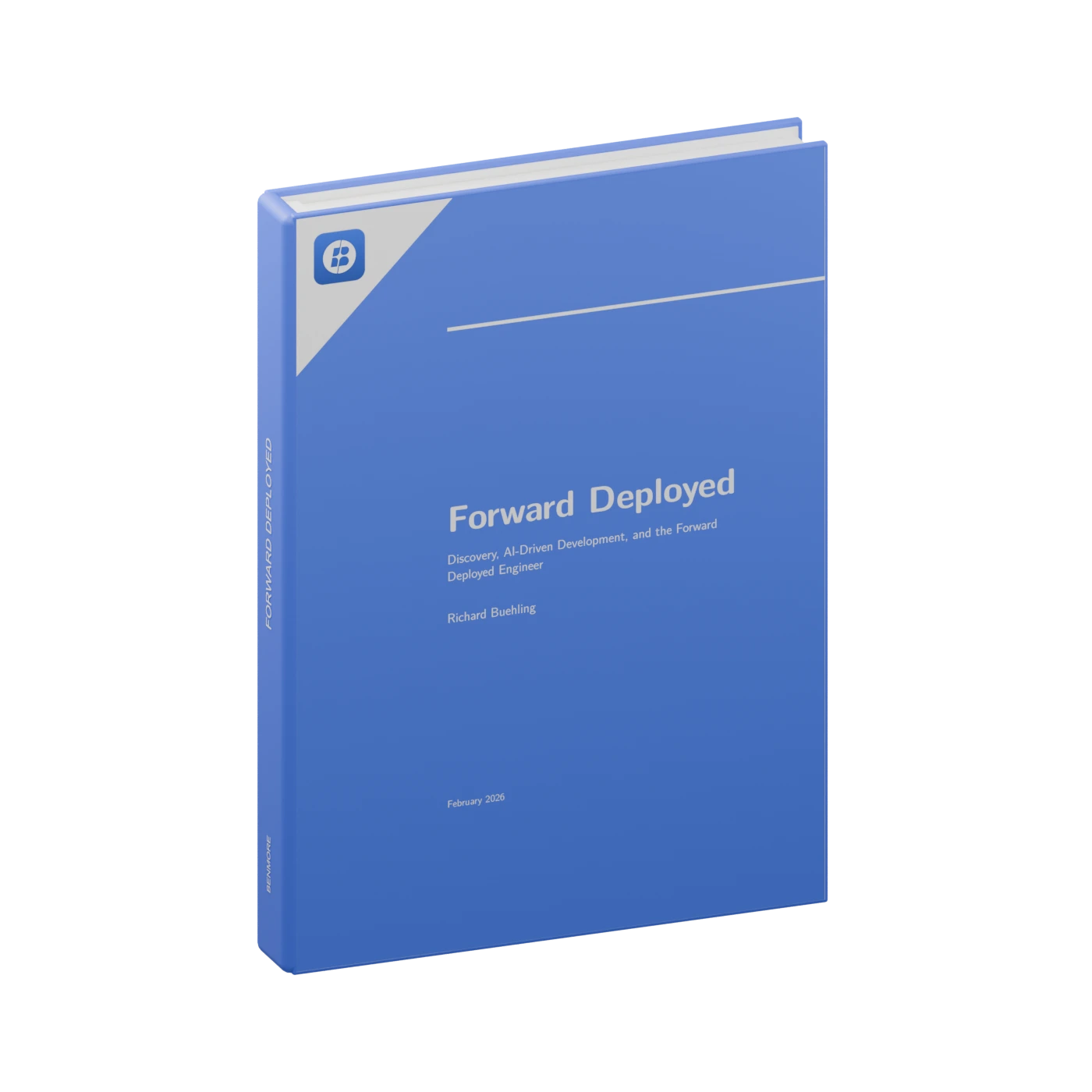
Forward Deployed, the Benmore book, is out Read more →

Benmore Go

The runtime for
your next application.

A coding framework, application runtime, and hosting platform built for AI-assisted development. Define the data, configure access, and build your interface with your own tools or Benmore’s engineers.

Schema-driven APIsRuntime access controlMCP & CLIDev / prod hosting

A defined structure.
An extensible application.

Go gives engineers and coding agents a shared application contract. Your project defines the experience and business logic; the runtime handles the common services underneath it. Open the architecture below to see where each responsibility lives.

Inside the Go runtime

Benmore Go

01 / Project

Three inputs.
One application.

The project starts with a Prisma schema, YAML configuration, and a frontend. Engineers and AI clients work against that same structure through MCP or the CLI.

schema.prisma / app.yaml / static/
02 / Runtime

The schema becomes
a working backend.

Data definitions drive the API and typed SDK. Authentication and access rules are enforced by the runtime, so each feature uses the same rules for reading and changing records.

Data → API → typed client

03 / Logic

Add the behavior
your product needs.

Hooks react to record changes. Flows coordinate server actions. Workflows define states and transitions. The interface calls into these services instead of reimplementing them.

Hooks / flows / workflows

04 / Deploy

Review in dev.
Release to production.

Development and production have separate data and secrets. Promote application code after review, then keep iterating without treating the live environment as a draft.

One project. Separate environments.

Application services,
built into the runtime.

The project defines what is specific to your product. These shared services keep the foundation consistent as the application grows.

01

Schema & API

Prisma models become tables, CRUD routes, and a generated TypeScript SDK.

02

Auth & authorization

Session handling, roles, and record access are enforced on the server.

03

Hooks & flows

Express side effects, custom routes, and ordered server actions alongside your application.

04

Real-time & files

SSE, WebSocket rooms, and uploads connect through the same application runtime.

05

Environments

Review changes in development before promoting code to production.

06

Hosting & recovery

HTTPS, custom domains, backups, and application version history support ongoing delivery.

The application contract

From a data model
to a working interface.

A small support application illustrates the relationship between a record, its access rules, and the code that uses it.

01

Define the record once.

A ticket has a subject and an owner. That definition supplies the structure the runtime and client can work from.

schema.prismaPrisma
model Ticket {
  id      Int    @id @default(autoincrement())
  subject String
  userId  Int    @map("user_id")
}

Illustrative application code

02

Put record access in configuration.

In this example, ticket access is scoped to its owner. The interface can change while the server remains responsible for enforcing the rule.

app.yamlYAML
access:
  tickets:
    read: self
    write: self
    update: self
    delete: self

Owner-scoped access example

03

Use the generated client.

The frontend requests tickets through the SDK. It consumes the application API without holding database credentials or deciding whose records are accessible.

static/app.tsxTypeScript
import bm from 'bm';

const tickets = await bm.table('tickets').list({
  limit: 20
});

Illustrative client request

Build with your team.
Or build with ours.

Benmore Go is the foundation in both cases. Choose the level of engineering support that fits your product and your team.

01

For your team

Use a supported AI client or your terminal workflow to build on Go. Your team sets the direction, reviews the application, and decides when it is ready to release.

02

With Benmore

Our forward deployed engineers handle discovery, product development, and launch with you. We stay involved as the product grows and the work changes.

Build with the tools you use
ClaudeChatGPTCursorCodexTerminal
Connection guide

Questions about
Benmore Go

What is Benmore Go?

Benmore Go is our framework, application runtime, development tooling, and hosting platform. It gives custom software a consistent foundation and supports development with AI assistants, your own engineers, or Benmore’s team.

Can I use the AI tools I already have?

Yes. Go supports connecting an AI client through MCP or working through the Benmore CLI. The connection guide covers the supported clients and setup. View the connection guide.

Can Benmore build the application for me?

Yes. We work with founders and business teams on discovery, custom development, deployment, and ongoing support. The first step is agreeing on the problem, the users, and the scope of the first release.

Where does my application run?

Applications can be hosted on Benmore Go. The platform documentation explains deployment, domain configuration, development environments, and the hosting controls available to your team.

How is Go different from Substrate?

Go is the foundation for building and running applications. Substrate is the organization-wide layer that connects systems, defines shared business data, coordinates work, and applies governance. Go supplies the application-building capability within Substrate.

How does pricing work?

Go platform plans are listed on benmore.ai. Work delivered by Benmore’s engineers is scoped separately around your product and delivery needs. See current platform plans.

Let’s build
something useful.

Bring the product you have in mind. We’ll help shape the scope and work out how to deliver it.